"The human body is just a machine. Sometimes it breaks down and needs repairs or spare parts, but eventually the breakdown is irreparable and life ends. When the body dies, some parts might be salvaged to repair other bodies, but for that particular body it is all over."
Atheistic Outreach Pro-Outreach Advice from an Agnostic Baptist Minister: Culture-Jamming Theistic Memes Effectively…but Respectfully (n.d.) by Anonymous “Culture jamming the theistic memes” is a perfectly legitimate enterprise if that is what one believes will make a positive difference in the world. Keep in mind, however, that it will be most successful reaching those not already […]
(2015) One can readily find evidence of the low regard that various religions have for the disabled. Like religious misogyny (or “hatred of women”: see Kramer & Moore, 2002), prejudicial practices against the disabled often have doctrinal justification. In this essay I (a) cite scriptural sources for these attitudes, (b) describe some of the discriminatory […]
Many Christians maintain that, in principle, atheists can never "prove the negative" that God does not exist. But atheists often regard this objection as a mere quibble, counterclaiming that the burden of proof rests solely upon the believer who has claimed knowledge of a supernatural being. In "Proving a Negative" Richard Carrier argues that proving the nonexistence of God is actually relatively easy, making passing appeals to the role of evidence in epistemology and the presumed incoherence of Christian theology. But in taking this position Carrier has assumed a substantial burden of proof, a burden that his arguments fail to meet.
In this response to Don McIntosh's "Transcending Proof," Richard Carrier explains how McIntosh does not actually address the logic or arguments Carrier makes in his "Proving a Negative," and updates its logical structure to make the same point using Bayesian epistemology.
"When anyone tells me that he saw a dead man restored to life, I immediately consider with myself, whether it be more probable that this person should either deceive or be deceived, or that the fact, which he relates, should really have happened."
--David Hume
"This is my argument for not believing in god. If others choose to believe despite his failings then that is their business. I have no argument with them; they are entitled to believe whatever they want. But don't expect me to go along with them and agree."
While it may at first glance seem a stretch to make a comparison between the Titanic and Christian apologetics, a fundamental truth exists within that comparison: namely, that so-called experts do make mistakes, and that it is unreasonable and potentially misleading to assume that they are always correct. It should be noted that experts designed, built and sailed the Titanic on its fateful maiden voyage and that each of those disciplines had a hand in its ultimate destruction. Unfortunately, Christian tradition and its accompanying apologetics fare no better in their claims of unassailable accuracy in portraying the life of the historical Jesus.
Theology professor Alister McGrath's Christian Theology: An Introduction is a clear and comprehensive theology textbook that is balanced, at least, when presenting conflicting Christian opinions. This review by Michael Reynolds from the perspective of a nonbeliever is not intended to be comprehensive, but focuses on McGrath's treatment of issues found to be incomplete or misleading, or otherwise his omissions of discussion (or even mention) of large and important topics within Christianity. Some of these topics include the pernicious effects of Christian theology on social progress (such as equal rights for men and women), the conflict between science and religion, Christianity's history of suppression of thought by imprisonment, torture, and murder, religious wars, and rationalization of the conquest of non-Christian cultures. In short, McGrath neglects a large swath of issues close to the heart of Christianity in a way that suggests that Christian theology is taught in order to promote a set of fictions.
"Religions fill a deeply felt need. Throughout history, practically all societies, whether isolated tribes or complex civilizations, have had some sort of belief system in the form of a religion. If something as ubiquitous and seemingly necessary as religion is actually a false concept, significant consideration ought to be given to what might replace it."
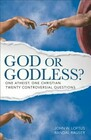
Description Perhaps the most persistent question in human history is whether or not there is a God. Intelligent people on both sides of the issue have argued, sometimes with deep rancor and bitterness, for generations. The issue can’t be decided by another apologetics book, but the conversation can continue and help each side understand the […]
"Occasionally apologists will ask me what I would consider to be sufficient evidence to believe that Jesus resurrected from the dead. Fair enough. Seeing as I deny that there is sufficient evidence to reasonably believe in the resurrection, what amount or type of evidence would I consider adequate to meet the onus probandi for establishing such an extraordinary claim? The best approach that I have found to answering this question is by an equally extraordinary analogy."
"There are saints who are inoffensive, such as the protohippie Francis of Assisi. But the saints officially canonized by the Church include a shocking number of persons who, in all honesty, must be considered major nut cases. It's an indication of how deranged the religious impulse can be that their lunacy is not merely unrecognized, but reinterpreted as an expression of supreme sanctification."
"Even Catholics don't know very much about the Popes. If they did, they might well wonder how such an assortment of buffoons and villains could ever have been given the job. Why, it could make one lose faith in the infallible guidance of the Holy Spirit! Presented here are some of the more interesting and juicy cases."
The God Problem: How a Godless Cosmos Creates is a recent offering by sociologist and rock 'n' roll publicist Howard Bloom. The book claims to have answered a question that cosmologists and philosophers have been asking since the origins of their fields: How could something as spectacular as the universe have come to be without a divine intelligence devising and setting it into motion? The only attempt the book actually makes at solving the God problem is by outlining what is referred to as, "the Bloom Toroidal Model of the Universe," (also called "the big bagel theory").
Is God needed for life to be meaningful? Is it even conceivable that the meaning of life could be found in God? Would the existence of God, one way or the other, have any implications for the meaning of life at all? And what exactly do we mean by the meaning of life, anyway? This essay touches on these and related questions in order to elucidate the relationship between the existence of God and the meaning of life.
Intensive study of the Old Testament, reading critically and analytically rather than reverentially and devotionally, casts serious doubt on the claim that Moses was the author of the first five books of the Bible, the Pentateuch. Not only that, but even the historicity of Moses is in serious doubt.
Christian leaders teach that the Bible is inerrant and authoritative, often referring to it as "The Good Book." They encourage us to read it, but they evidently realize that most of us will only read the recommended passages, accompanied by a good dose of interpretation, and that only a few of us will ever read it from cover to cover, and then form our own opinions about what it actually says. If all of us were to sit down and read the Bible straight through--and then actually put into practice what it admonishes us to do--civilization would be dealt a devastating blow from which it might never recover. That may seem to be a surprising conclusion, but the author makes a convincing case for it simply by looking at what the Bible itself actually says.
"I am not shocked that the believers I interact with doubt the efficacy against theism of the problem of evil argument, but I am shocked that almost all of them really fail to convince me that they take the objection seriously. I would like to investigate this failure and also lay out some helpful ways of effectively communicating the problem of evil to ordinary believers."
David Chalmers argues that conscious experience is a real but nonphysical feature of nature. However, he also believes that all particular facts about any conscious experience supervene (naturally, but not logically) on physical facts, such that physical facts fully determine any conscious experience. His principle of organizational invariance goes even further to claim that fine-grained functional organization fully determines any conscious experience (naturally, but not logically). This principle has powerful implications for artificial intelligence, allowing for the possibility of fully conscious digital computers. But the principle of organizational invariance is not compatible with the concept of a personal soul. This paper does not attempt to prove or disprove the existence of a personal soul, but defends its conceptual coherence against the challenge presented by Chalmers' principle of organizational invariance.
What authority can we trust to provide good answers to life's big questions? For questions about the physical world--how it got here, how it works, where we came from--the discoveries of science give us honest and reliable answers. But science does not claim to know the answers to moral and social issues, which are of utmost importance because they determine how well we can live together. Religions do claim to have the answers in this area, but how good are their teachings? A careful look at moral issues addressed by religions can tell us a lot, and maybe even provide a guide to validating our own moral choices.
What is real, and how do we know it? Religions and science put forward quite different answers to those questions, the gap becoming wider as the religious thinking becomes more fundamental. A comparison of the workings of religion and science shows which one we should trust for answers, even if we don't always have the interest or the patience to learn about and understand scientific discoveries (or to wade through religious rhetoric).
Description Written in a respectful and conversational style, this unique book is designed to promote constructive dialogue and foster mutual understanding between Christians and non-Christians. The author, a skeptic and journalist, asks basic questions about Christian belief. What is the born-again experience? Why would God want to sacrifice his only son for the world? Do […]
The group of people commonly referred to as Nones includes atheists agnostics, secular humanists and a variety of other skeptics and freethinkers all of whom have one thing in common--they are not affiliated with any organized religious group. Although some of them do believe in a Creator or some form of Supreme Being, most are nonbelievers, albeit with varying degrees of conviction. But they also have one other characteristic in common. If they reveal their disbelief--especially if they use the word "atheist," then they become targets of criticism, victims of ostracism and charges of "anti-Americanism."
This paper makes the case for a logical inconsistency between the existence of evil or suffering and the existence of an eternal, omniscient, omnipotent, completely free, perfectly rational, and maximally good God. In essence, the paper argues that because God is maximally good, the reality existing before the creation of the natural world, consisting as it does only of God and perhaps morally neutral necessary things or necessarily coexisting things, will be maximally good. Furthermore, as a maximally good being, God would never introduce any evil or anything that could produce evil into existence, for that would only serve to make reality worse. But there is in fact evil in the world; therefore God does not exist. The paper considers several objections to the argument, but finds that none of them succeed.
Here is a problem: On the one hand, human society cannot survive without an injunction against the wanton killing of fellow human beings. On the other hand, man is an aggressive animal. Dehumanization (i.e., the likening and equating of human beings with animals) is often used by religions to justify the killing of others. While one code says "an eye for an eye," another commands you to "love your enemies." Here you read "Thou shall not kill!"; there you find "Slay the idolaters wherever you find them."
"As a humanist psychotherapist my view is that to promote secular ethics and create a humanistic world, we need to respect human rights and associate sex with love and affection, rather than sin and guilt. To grow as a human species and evolve as sexual beings, we need to embrace advances in science and psychology rather than age-old scriptures that impose contradictory sexual morals and create fear in people."
Richard Smith had been a lifelong Christian until he underwent an unexpected deconversion in 2011 at the age of 54. "From the Outside" explains his reasoning. As one of our reviewers commented: "Comprehensive in its coverage, has emotional impact, and is meaningful in its intent. Welcome to the sane world of atheism."
"By most religious reckoning, history is and always has been a foregone conclusion. All wisdom, all grace, all law was bestowed upon human beings long before the arrival of any now present, and so there is nothing for the living to do but fulfill someone else's plan for them. We are relieved of the burden of free will and responsibility for our misdeeds by a simple act of repentance. In effect, God finished us, and long ago. When a human being rejects this conception of the universe, they simultaneously reject the hubris and vanity required to create it in favor of a universe where real choice reigns, along with real possibility, opportunity, discovery, maturity and the right to know."
Stephen Meyer tries to make the case for "teaching the controversy" between Darwinian evolution and intelligent design by arguing (1) there is, in fact, such a scientific controversy, (2) voters support the idea of teaching the controversy, (3) the Constitution allows for and encourages the idea of teaching the controversy, and (4) that it makes good pedagogical sense to teach the controversy. I show that each of these points is either false or irrelevant. Further, Meyer charges the scientific community with censorship in keeping intelligent design out of textbooks and the classroom. To show this charge is false, I consider the lengthy evolution of continental drift/plate tectonics from novel concept to scientific orthodoxy.
We use cookies on our website to give you the most relevant experience by remembering your preferences and repeat visits. By clicking “Accept”, you consent to the use of ALL the cookies.
This website uses cookies to improve your experience while you navigate through the website. Out of these, the cookies that are categorized as necessary are stored on your browser as they are essential for the working of basic functionalities of the website. We also use third-party cookies that help us analyze and understand how you use this website. These cookies will be stored in your browser only with your consent. You also have the option to opt-out of these cookies. But opting out of some of these cookies may affect your browsing experience.
Necessary cookies are absolutely essential for the website to function properly. These cookies ensure basic functionalities and security features of the website, anonymously.
Cookie
Duration
Description
cookielawinfo-checkbox-analytics
11 months
This cookie is set by GDPR Cookie Consent plugin. The cookie is used to store the user consent for the cookies in the category "Analytics".
cookielawinfo-checkbox-functional
11 months
The cookie is set by GDPR cookie consent to record the user consent for the cookies in the category "Functional".
cookielawinfo-checkbox-necessary
11 months
This cookie is set by GDPR Cookie Consent plugin. The cookies is used to store the user consent for the cookies in the category "Necessary".
cookielawinfo-checkbox-others
11 months
This cookie is set by GDPR Cookie Consent plugin. The cookie is used to store the user consent for the cookies in the category "Other.
cookielawinfo-checkbox-performance
11 months
This cookie is set by GDPR Cookie Consent plugin. The cookie is used to store the user consent for the cookies in the category "Performance".
viewed_cookie_policy
11 months
The cookie is set by the GDPR Cookie Consent plugin and is used to store whether or not user has consented to the use of cookies. It does not store any personal data.
Functional cookies help to perform certain functionalities like sharing the content of the website on social media platforms, collect feedbacks, and other third-party features.
Performance cookies are used to understand and analyze the key performance indexes of the website which helps in delivering a better user experience for the visitors.
Analytical cookies are used to understand how visitors interact with the website. These cookies help provide information on metrics the number of visitors, bounce rate, traffic source, etc.
Advertisement cookies are used to provide visitors with relevant ads and marketing campaigns. These cookies track visitors across websites and collect information to provide customized ads.