While Christianity professes belief in the existence of one god, the careful observer will find that Christianity actually presents us with three gods: the Tribal God, the Cerebral God, and the Absentee Landlord God. Additionally, because each of these three gods corresponds with a different stage in the development of human consciousness, with each stage representing a different conception of deity and the nature of the world, these three gods are ultimately irreconcilable, forming an "Irreconcilable Trinity."
Einstein once said that "God does not play dice." But he also said, "It seems to me that the idea of a personal God is an anthropomorphic concept which I cannot take seriously." What, then, did Einstein mean by "God"? What sort of "God" did Einstein have in mind?
Antony Flew. a long-time ace atheist and once-astute philosopher, now a born-again deist, responded to Bradley's "Antony in Wonderland," by appealing to Gerald Schroeder's Genesis and the Big Bang--calling Bradley a "secularist bigot" in the process. Bradley responds.
Pyrophobia, people's fear that they will go to hell if they do not believe propositions x, y and z, is a significant barrier to the use of reason that arose in European/American history. It was pervasive in Puritan times and it is pervasive today. No one wants a one-way ticket to hell, of course, but pyrophobia can nevertheless be overcome.
The Failure of Daniel’s Prophecies (2007) Chris Sandoval Introduction Honest Inspirational Fiction Daniel’s Four Empires The Symbolism of the Statue and Beasts The Greek Four-Empire Scheme The Origin of “Darius the Mede” Was “Darius” an Alias? Mixed Messages The Brutality of the Fourth Empire The Diadochi The Maccabean War The Traditional Christian Interpretation of the […]
Review of Reasonable Faith (2007) Chris Hallquist Review: William Lane Craig. 1994. Reasonable Faith: Christian Truth and Apologetics. Wheaton, IL: Crossway Books. 350 pp. Overview Introduction Chapter 1: Faith and Reason: How Do I Know Christianity is True? Chapter 2: Man: The Absurdity of Life Without God Chapter 3: God: The Existence of God Chapter […]
In this autobiographical account of his journey from Baptist fundamentalist to freethinker, Raymond D. Bradley outlines his reality-driven philosophical predisposition and the difficulties it generated for his acceptance of traditional Christian doctrines throughout his childhood. These difficulties with specific doctrines--several of which Bradley discusses in detail--matured into a brief stint with deism before finally culminating in full-blown, outspoken atheism.
"The same glorious past that lends us our cultural pride has bestowed upon us some of the darkest curses of mankind. Our inheritance has been flawed and imperfect. The evil of the caste system continues to irk us even into the twenty-first century. Likewise the ugly chapters of violent evangelism and inquisition serve as fodder to the perverted mind. Nationalism often simmers up to fascist ideology and religious bigotry when it derives inspiration from such flawed perception of history. Routinely, extremist groups and religious bigots twist history to spread their divisive philosophy."
Daniel C. Dennett has provided a valuable insight into the operation of the conscious mind in his book, Consciousness Explained. This work demolishes the fallacy of the Cartesian Theater and replaces it with a scientifically verifiable Multiple Drafts model. Dennett disqualifies the mystery of qualia but conspicuously neglects the much greater mystery of sentience. Most interestingly, he not only acknowledges sentience in his later book, Kinds of Minds, but also admits to both its great moral implications and lack of present explanation. This discussion is not intended as a book review but rather as a critique of Dennett's claim that anything fitting his Multiple Drafts model is conscious in the fullest sense.
According to Alister McGrath, the early 21st century marks the decline of atheism. In this critique of McGrath's arguments, Keith Parsons considers whether the intellectual clout, stature, or influence of atheism has in fact declined in recent years, concluding that McGrath does not even begin to address the real intellectual case for atheism. That disbelief in God is just as much a matter of faith as belief in God can only be a stale platitude from McGrath given his failure to even superficially survey the best arguments for atheism. McGrath does address, however, four charges made by Richard Dawkins against religion, including the charge that evolution makes God unnecessary as an explanation and that religion is a source of much of the misery in the world. Parsons concludes that once one appropriately qualifies or refines Dawkins' accusations, McGrath's critique fails to adequately address the underlying problems for religion that inspire them. Moreover, to the extent that the influence of inherently controversial and divisive religions on people's lives grows, a corresponding dawn of the popularity of atheism is inevitable.
In Kingdom Coming Michelle Goldberg lets America's "Christian Reconstructionists," who openly advocate making the Bible the basis of a shari'a-type religious law, speak for themselves. Though considered extreme even within the religious right, an offshoot called dominionism, or Christian Nationalism, openly advocates theocracy and is rapidly gaining ground among "mainstream" right-wing Christians. Those swept away in this fundamentalist counterculture live in a universe that they have created, separate from and parallel to the one that the rest of us live in. The immediate danger they pose is not their impact on social issues, but the subversion of rationality itself, which has been achieved to an alarming extent. Today the best established scientific conclusions are routinely undermined and derided, and even the mainstream media feel that they have to offer "balance" on scientific issues by giving equal time to cranks and crackpots. The religious right is motivated, organized, and well-funded, and they are not going away. We ignore them at our peril. Goldberg has done us a service in giving us a beautifully crafted statement of why we fight.
"According to the Selfish Gene theory, there is no meaning to life beyond the meaningless reproduction of genes: we are just survival machines for our genes. I suggest that, notwithstanding the initially unpromising impression, the Selfish Gene theory, when taken in conjunction with the creativity thesis below, can be liberating, and can lend to constructing a meaning or purpose to life, bringing about peace, prosperity, care for the environment, and harmonious social coexistence."
"I like to find secular counterpoints to Christmas, not secular counterparts. That, in a nutshell, is the topic of this essay. There is a secular side to Christmas, one that a nontheist can enjoy with the rest of society without betraying their nontheist views. In fact, I propose that the very shape and spirit of the holiday is significantly nonreligious, from twinkling lights and fake snow to the eggnog and fruitcake. Yes, Virginia, there is an atheist's Christmas!"
Kiefer posits that the strategies employed by fundamentalist Christians to induce doctrinal belief diminish human potential by evoking fear and guilt, and by promoting powerlessness in adherents. The author illustrates the adverse effects suffered by adherents, he discusses the maladaptive coping strategies developed as a result of these beliefs, and he demonstrates how circular reasoning entraps believers and leaves them ignorant of their helplessness. Finally, he describes how personal vulnerabilities are manipulated by rigid doctrine and strict authority in order to control adherents and propagate the religion.
Nearly every religion asserts that human beings possess a soul or immaterial eternal essence, a "ghost in the machine" that animates our flesh. However, this extraordinary assertion is backed by essentially no hard, scientific evidence. Science makes it quite clear that the brain is the place in which one's personality, character and memory are stored. Only one conclusion can be drawn from the available scientific evidence: "Mind" is merely a self-organized emergent property of matter.
The God Delusion is a witty, razor-sharp attack on religious belief of all varieties. Dawkins pulls no punches and does not hesitate to heap scorn on foolish beliefs. Atheists will cheer it; believers will probably be appalled and bypass it, which is unfortunate, since this book presents a great deal of legitimately new and interesting information, and closes with a passionate and powerful defense of atheism that should be heard by all.
This is a general review of the last four chapters, the chapters that deal with evolution, of Ann Coulter's book Godless. "She is a lawyer and a journalist, and the research techniques she uses to study political and historical subjects, which in this case amount to 'quote mining,' are not suitable for studying issues in biological science. What makes her account bearable is her acid wit. She is genuinely funny."
Without dwelling on deep theological issues and arguments, Holt details his journey from Catholic to naturalist, outlining the reasons that led him to give up his belief in God and the supernatural, and to ultimately come to the conclusion that metaphysical naturalism is most likely true.
Well written in an artistic but critical style, Günther Bornkamm's Paul attempts to outline Paul's life and work before finally turning to his theology and gospel. While drawing on the work of several New Testament scholars, Bornkamm largely relies on his own interpretation of the Pauline epistles, Acts, and the interplay between them, leaving the reader to evaluate his arguments primarily on their own merits. Against source-critical methods, Bornkamm occasionally uses the texts he has judged as inauthentic as reliable sources of information without recourse to any clear criteria, and dismisses uncomfortable passages attributed to Paul as inauthentic without offering any supportive arguments. This ad hoc pick-and-choose methodology leaves his presumptions open to criticism where the texts are silent or in conflict. But otherwise Paul is a great book, generally utilizing critical evaluation of the sources to unravel Paul's ingenious and enigmatic character.
The legitimacy of the three main commandments of the Gospels--"Do unto others as you would have them do unto you," "Love your neighbor as yourself," and "Love God with all your heart with all your soul and with all your mind"--is accepted not only by believers, but the first is admired by many unbelievers as well. However, although they sound pretty, they do not pass philosophical scrutiny, and they must be rejected by a morally-minded and reasonable person.
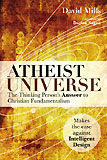
New Expanded Edition The world’s best-selling book on atheism just got better. Building upon two years of voluminous reader feedback, David Mills has just revised and expanded Atheist Universe to include all the latest arguments and debate, including detailed rebuttals to the newest Christian books on “Intelligent Design.” The New Edition (published August 28, 2006, […]
O'Kane argues that even if a punishing god were to exist, it would remain a logical and ethical necessity to behave as if it did not, that to succumb to such a being would be a moral failure, and that the only moral course of action would be nonbelief and the acceptance of damnation--"in essence, the virtuous must all 'go to hell.'"
"Theists frequently make the assertion that it is just as impossible to prove that there is no such thing as god as it is to prove that there is such a thing as god; therefore, atheism (the positive assertion that no god can exist) is rooted in blind faith, just as theism (the positive assertion that a god does exist) is. I believe, however, that there is a rational basis for the positive assertion that god cannot exist, which can be arrived at through extrapolation on empirical evidence, and through deductive reasoning regarding the properties of the universe."
One of the clearest statements of the case for a Creator is written by Roy Abraham Varghese in his introduction to the volume Cosmos, Bios, Theos. Here Varghese argues that the best explanation for why there is something rather than nothing necessarily terminates in God, rather than the ultimate features of the physical universe, for unlike any physical thing, God is self-explanatory. But we are left completely in the dark on the sense in which God is self-explanatory, and how that would differ from the self-explanatoriness of a putative original, uncaused state of the physical universe. Consequently, I argue that there is no intellectual difficulty in postulating an initial state of the universe as a ultimate brute fact, and conclude that Varghese's arguments to the contrary fail.
A popular theistic "explanation" for why God would permit even a slim evidential basis for atheism goes something like this: "God does not give us absolute proof because this would work against our free will. He gives us just enough evidence so that we can find Him and just enough to reject His existence if that is our desire." But is this reasonable? Kuchar says not.
One of the most acclaimed poets and Latin scholars of the twentieth century, Housman's poetry and prose contain eloquent observations palatable to atheists.
Those who advocate displaying the decalogue in classrooms, courtrooms, and public parks assert that the Ten Commandments are a declaration of fundamental principles that are the cornerstones of a fair and just society. But a careful study of the Bible indicates that it isn't as simple as that; there are many questions that would need to be answered before it could be decided which version and which interpretation--if any--should be displayed.
The Bible portrays God's moral judgments and punishments in many instances as arbitrary and inconsistent, holding people accountable for rules they may not be aware of. The Bible's treatment of incest is only one example of the Scripture's inconsistent moral judgments. Gay Christians and every other demographic should eschew wasting time reconciling their ideas about morality to such an arbitrary and inconsistent standard.
In Finite and Infinite Goods, Robert Merrihew Adams offers an interesting variation on G. E. Moore's famous open-question argument against ethical naturalism. In giving causal-explanatory reasoning the last word in ethical inquiry, he says, ethical naturalists negate a critical stance that permits us to raise evaluative questions about any ethical judgment, no matter how well-supported empirically. But Adams's version of the open-question argument is deeply confused. First, modern science shows that the relevant critical stance is quite compatible with giving causal-explanatory reasoning the last word. Second, ethical naturalists need not treat any ethical judgments as immune to criticism. Finally, if Adams's argument were sound, it would undermine his own case for a divine-command theory of ethics.
This is a response to an article by Rabbi Gellman entitled, "Trying to Understand Angry Atheists: Why do nonbelievers seem to be threatened by the idea of God?" Parra contends that because clergy have a vested interest in invalidating affronts to their theology, Rabbi Gellman runs through every "tired assumption that every smug believer uses to convince himself that he is somehow morally superior to those who reject his faith."
We use cookies on our website to give you the most relevant experience by remembering your preferences and repeat visits. By clicking “Accept”, you consent to the use of ALL the cookies.
This website uses cookies to improve your experience while you navigate through the website. Out of these, the cookies that are categorized as necessary are stored on your browser as they are essential for the working of basic functionalities of the website. We also use third-party cookies that help us analyze and understand how you use this website. These cookies will be stored in your browser only with your consent. You also have the option to opt-out of these cookies. But opting out of some of these cookies may affect your browsing experience.
Necessary cookies are absolutely essential for the website to function properly. These cookies ensure basic functionalities and security features of the website, anonymously.
Cookie
Duration
Description
cookielawinfo-checkbox-analytics
11 months
This cookie is set by GDPR Cookie Consent plugin. The cookie is used to store the user consent for the cookies in the category "Analytics".
cookielawinfo-checkbox-functional
11 months
The cookie is set by GDPR cookie consent to record the user consent for the cookies in the category "Functional".
cookielawinfo-checkbox-necessary
11 months
This cookie is set by GDPR Cookie Consent plugin. The cookies is used to store the user consent for the cookies in the category "Necessary".
cookielawinfo-checkbox-others
11 months
This cookie is set by GDPR Cookie Consent plugin. The cookie is used to store the user consent for the cookies in the category "Other.
cookielawinfo-checkbox-performance
11 months
This cookie is set by GDPR Cookie Consent plugin. The cookie is used to store the user consent for the cookies in the category "Performance".
viewed_cookie_policy
11 months
The cookie is set by the GDPR Cookie Consent plugin and is used to store whether or not user has consented to the use of cookies. It does not store any personal data.
Functional cookies help to perform certain functionalities like sharing the content of the website on social media platforms, collect feedbacks, and other third-party features.
Performance cookies are used to understand and analyze the key performance indexes of the website which helps in delivering a better user experience for the visitors.
Analytical cookies are used to understand how visitors interact with the website. These cookies help provide information on metrics the number of visitors, bounce rate, traffic source, etc.
Advertisement cookies are used to provide visitors with relevant ads and marketing campaigns. These cookies track visitors across websites and collect information to provide customized ads.